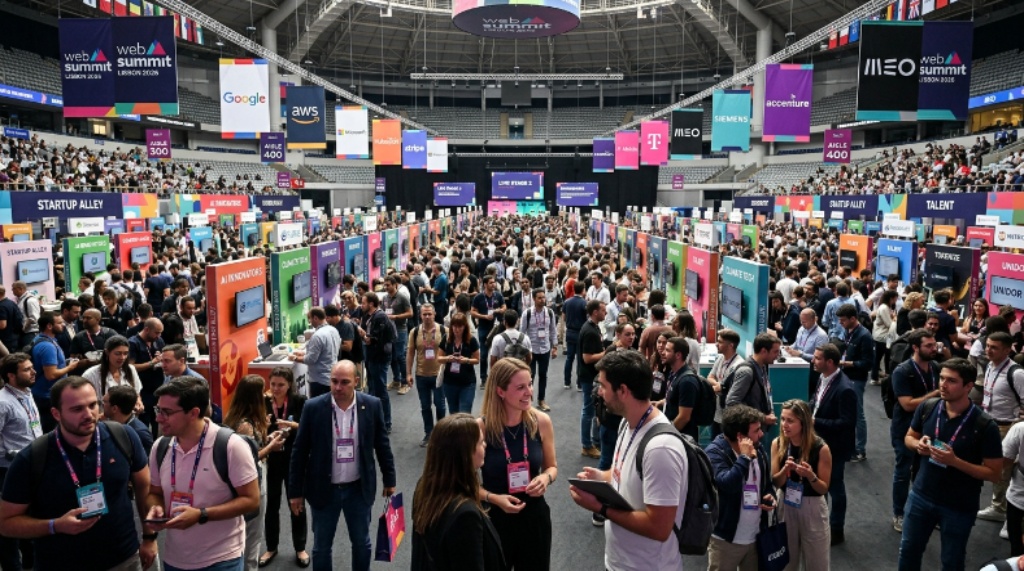
Every November, Lisbon transforms into a global hub for technology, innovation, and big ideas. Tens of thousands of people fly in from every corner of the world. Founders meet investors in busy corridors. Deals get signed over coffee. New companies are born. This year, the energy is higher than ever.
Web Summit Lisbon 2026 runs from November 9 to 12 at the MEO Arena and FIL exhibition center in Lisbon’s Parque das Nações district. It is expected to draw over 70,000 attendees from more than 160 countries, alongside 900+ speakers and 2,000+ startups. These are not just impressive numbers. They represent an unmatched concentration of the people and ideas shaping the next decade of technology.
So why does 2026 feel especially significant? The answer lies in timing, context, and the conversations the world urgently needs to have.
A Critical Moment for the Tech Industry
The technology sector is at an inflection point. Artificial intelligence has moved from a buzzword into the center of nearly every business decision. Venture capital markets have gone through turbulence. Geopolitical pressures are redefining where software gets built, who controls the data, and how companies expand across borders.
Additionally, questions of trust and accountability in tech have never been more prominent. Governments around the world are introducing new regulations. Companies are navigating the balance between rapid innovation and responsible deployment. These tensions do not resolve themselves in a boardroom. They get worked through in open dialogue, across panels, roundtables, and the informal conversations that happen when the right people are in the same room.
That is precisely what Lisbon offers in November. It is one of the few events where policymakers sit alongside startup founders, where enterprise executives share a stage with independent researchers, and where a developer from Nairobi can meet an investor from Singapore in the same afternoon.
What Makes Web Summit Different From Other Tech Conferences
Many large technology conferences exist. However, few operate at the scale and diversity of Web Summit. The event is not built around a single technology, company, or region. It spans the full breadth of global tech, making it a genuine mirror of where the industry actually is.
The conference features more than 20 specialized content tracks. These cover areas like generative AI and model deployment, fintech and open banking, deep tech, climate tech, SaaS and enterprise software, developer tools, and media and marketing. There is a track for almost every corner of the industry, which means attendees rarely feel like they are watching content that does not apply to them.
Furthermore, the structure of the event itself is designed to maximize useful connections. The official app uses AI-driven matching to recommend who you should meet based on your goals, industry, and interests. Investors can access a dedicated Investor Lounge, private receptions, and exclusive meetings with startups competing in the PITCH competition. Mentor Hours give founders direct access to experienced operators and advisors. Every element of the program is built to move people from conversation to action.
The AI Summit Track: Where the Industry Takes Stock
If there is one theme that defines Web Summit Lisbon 2026 more than any other, it is artificial intelligence. A dedicated AI Summit track runs throughout the four days, covering AI research, real-world applications, governance, and ethics.
This is not a track built for hype. The conversations expected here are harder and more grounded than the ones dominating headlines a few years ago. Speakers and panelists are expected to address what analysts are calling the “AI ROI reckoning.” In other words, are the enormous investments companies have made in AI actually translating into sustainable business value? That is a question every executive in every industry is trying to answer right now.
Sessions will also explore the engineering reality of deploying AI systems outside of controlled lab environments. Building something impressive in a test setting is one thing. Making it work reliably at scale, in messy real-world conditions, is something entirely different. The gap between those two things is where most AI projects currently live.
Additionally, the geopolitical dimension of AI will receive serious attention. Global chip supply chains, national AI strategies, and the question of who governs the most powerful AI systems are no longer niche policy discussions. They are business-critical decisions that affect every company operating internationally.
Startups at the Center: PITCH and the Startup Programme
One of the most distinctive features of this event is the role it gives to early-stage companies. Startups are not an afterthought at Web Summit. They are central to its identity.
The PITCH competition is one of the most anticipated moments of the week. Selected early-stage startups present live on the main stage in front of a global audience of investors, press, and industry leaders. The competition offers more than prize money. It offers visibility. A strong PITCH performance can change the trajectory of a company overnight.
Beyond the competition, startups can apply to one of three program tiers: ALPHA for very early-stage companies, BETA for those with some traction, and GROWTH for more established ventures. Each tier offers exhibition space, networking access, and the chance to meet investors actively looking for their next investment.
Therefore, for any founder thinking about where to invest time and resources this year, Lisbon in November is a serious answer. The density of decision-makers in one place is simply hard to match anywhere else on the global calendar.

Key Themes Shaping the Agenda
Fintech and the Future of Finance
Financial technology continues to be one of the most active and contested areas of global tech. At this year’s event, sessions will examine how AI-driven financial intelligence is changing the relationship between merchants, consumers, and traditional financial institutions. Open banking, embedded finance, digital identity, and payments infrastructure are all on the agenda.
The broader question underlying these conversations is whether the traditional financial system is ready for the pace of change happening around it. Many of the most interesting answers will come from the startups disrupting it from the outside.
Climate Technology and Sustainable Innovation
The Planet:Tech track brings together innovators working on climate solutions. Energy transition, carbon measurement, sustainable infrastructure, and the intersection of AI with environmental science are all expected to feature strongly. This is increasingly not a side conversation at tech events. It sits at the heart of how the industry understands its responsibilities and its opportunities.
Venture Capital in a Shifting Market
The state of venture capital will receive significant attention. After several years of market volatility, the investment landscape has shifted considerably. Sessions will explore the future of VC liquidity, the rise of secondary markets, the return of deep tech as a primary focus for investors, and how emerging markets are changing where the best deals are being found.
These are not abstract discussions. For any founder currently raising a round, or any investor trying to deploy capital wisely, these conversations carry real practical weight.
Governance, Trust, and Technology Policy
One of the more nuanced threads running through this year’s program is the question of governance. Who controls the systems shaping the economy and society? How should AI be regulated, and by whom? What responsibilities do technology companies have to the communities they operate in?
These questions were once treated as separate from business strategy. That is no longer true. Regulatory frameworks are now a competitive variable. Companies that understand and engage with policy are better positioned than those that ignore it.
Night Summit: Where the Real Conversations Happen
No account of Web Summit is complete without mentioning the Night Summit. Each evening, the conference extends beyond the formal venue into Lisbon’s bars, restaurants, and cultural spaces. These after-hours events are informal by design. They are where relationships move past the surface level.
Lisbon is, by any measure, a wonderful city in which to host these gatherings. Its compact center, warm November evenings, and rich cultural energy make it a natural setting for the kind of open, unhurried conversations that lead to real collaboration. Some of the most consequential partnerships formed at this event have started not on a stage but over dinner in Alfama or at a rooftop bar near the river.

Why Lisbon Itself Matters
The choice of Lisbon as the permanent home for this event is not accidental. Since the conference moved here in 2016, the city has evolved into one of Europe’s most dynamic technology ecosystems. Its growing startup scene, multilingual talent base, and gateway position between Europe, Latin America, and Africa make it a natural crossroads for global tech.
Additionally, Portugal’s government has been an active partner in making the event work. The relationship between the conference and the city reflects a shared investment in positioning Lisbon as a global innovation hub. That context makes the event feel embedded in its surroundings in a way that many conferences do not.
Who Should Attend and Why
The event attracts a genuinely diverse mix of participants. Startup founders come to raise capital and find partners. Corporate executives come to spot trends and meet the companies they may one day acquire or collaborate with. Investors come to find their next opportunity. Developers come to learn and connect with peers. Journalists come to report on what the industry is actually thinking.
However, there is also a compelling case for attending even if you do not fit neatly into any of those categories. If your work touches technology in any way, being in the room where these conversations happen is intrinsically valuable. Understanding where the industry is heading, hearing it directly from the people making those decisions, is a different kind of knowledge than what you can absorb from a newsletter or podcast.
Conclusion
Web Summit Lisbon 2026, running from November 9 to 12, is shaping up to be one of the most consequential technology gatherings of the year. The timing is right, and the conversations it will host are the ones the industry most needs to have. With over 70,000 attendees from 160+ countries, 900+ speakers, and 2,000+ startups, the scale alone is extraordinary. But the real value lies in the specifics: the AI Summit track tackling hard questions around real-world deployment and governance, the PITCH competition putting early-stage innovation front and center, the fintech and climate tech dialogues pushing entire industries to move faster, and the Night Summit turning Lisbon’s streets into a four-day networking marathon. Whether you are a founder, investor, executive, developer, or simply someone who cares about where technology is taking us, this is the event to watch closely in 2026.
Frequently Asked Questions
When and where does Web Summit Lisbon 2026 take place?
The event runs from November 9 to 12, 2026, at the MEO Arena and FIL exhibition center in Lisbon, Portugal, located in the Parque das Nações district.
How many people attend Web Summit each year?
The event typically draws over 70,000 attendees from more than 160 countries. This includes startup founders, corporate executives, venture capitalists, developers, journalists, and policymakers.
What are the main topics covered at Web Summit Lisbon 2026?
Key topics include artificial intelligence and its real-world deployment, fintech and embedded finance, climate technology, SaaS and enterprise software, deep tech, developer tools, venture capital trends, and technology governance and regulation.
How can startups participate in Web Summit?
Startups can apply to one of three program tiers: ALPHA, BETA, or GROWTH, depending on their stage. Eligible startups can also apply for the PITCH competition, where they present live on stage in front of investors and industry leaders. Applications are managed through the Web Summit website.
Is it possible to attend Web Summit remotely?
Web Summit offers some digital access to select livestreamed content, though the full experience is designed for in-person attendance. Details on virtual access are typically announced closer to the event date at websummit.com.