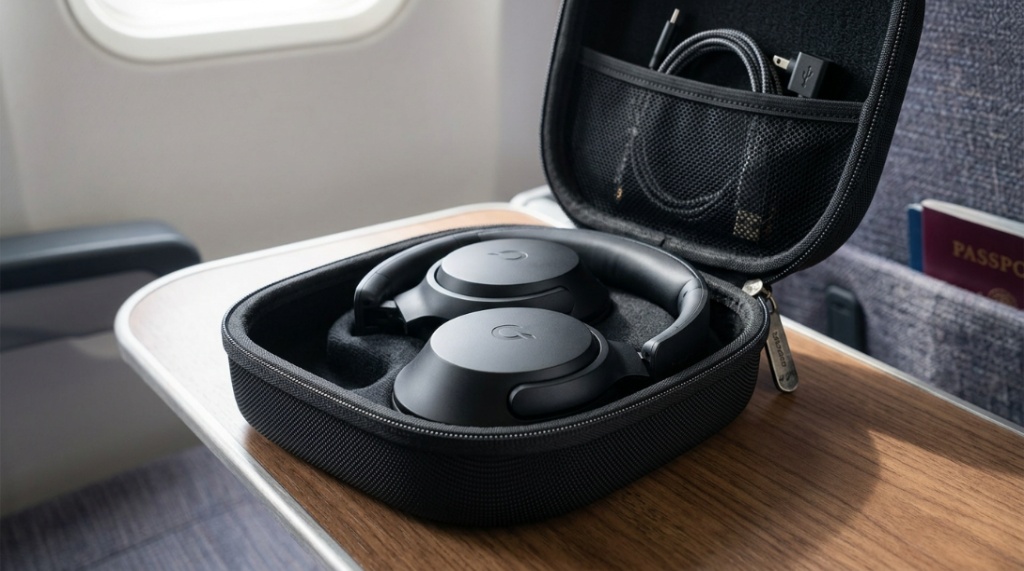
Families average 2.4 trips per year involving flights or long car rides, and the headphones that work perfectly at home on a desk often fail catastrophically in travel contexts where foldability, battery endurance, durability in bags, and comfort against vehicle seats become make-or-break requirements. Picking travel-friendly kids’ travel headphones means evaluating portability features (compact folding, protective case, lightweight), travel-specific durability (survives being thrown in backpacks), battery longevity (outlasts any journey without charging), and noise cancellation strong enough to handle the specific frequencies of airplane engines and car road noise.
and train vibrations that make travel environments uniquely loud. Travel-friendly kids’ headphones fold to half their size for packing, weigh under 200g, last 20+ hours per charge, include a wired backup for airline systems, and maintain child-safe volume limits across all connection methods. The mistake parents make? Buying “regular” kids’ headphones that technically work but weren’t designed for travel stress—they break in bags, die mid-flight from inadequate battery, can’t connect to airline entertainment, or refuse to fold into the limited space of a child’s carry-on. This guide identifies what genuinely survives and performs across every travel scenario families encounter.
What Makes Headphones “Travel-Friendly” for Kids Specifically?
Travel-friendly kids’ headphones must survive being stuffed in backpacks, endure being sat on, fold compact enough for child-sized bags, last longer than any foreseeable journey on a single charge, and connect to every audio source encountered during travel without adapters.
Travel-friendly requirement checklist:
| Requirement | Why It Matters for Travel | Minimum Spec | Ideal Spec |
|---|---|---|---|
| Foldable design | Must fit in child’s backpack alongside books, toys, snacks | Flat-fold | Compact fold + hard carrying case |
| Battery life | Must outlast flights + layovers + delays without charging access | 20 hours | 30+ hours |
| Wired option | Airline entertainment requires 3.5mm; Bluetooth not always available | Included aux cable | Aux cable + airplane dual-prong adapter |
| Durability | Thrown in bags, dropped on airport floors, stepped on in car seats | Flexible headband (bend without breaking) | Reinforced hinges + flexible headband + replaceable parts |
| Weight | A child carries own bag through airports; weight adds up | Under 200g | Under 175g |
| Quick charge | Emergency charge during short layover if battery runs low | Any USB-C charging | 10-min charge = 2+ hours playback |
| ANC for transport noise | Aircraft engines, car road noise, train vibration | 20dB reduction | 25–30dB reduction |
How Do You Choose Between Foldable Designs?
Choose flat-fold designs for maximum bag compatibility (slide between items like a book) or compact-fold designs with included hard cases for maximum protection—with flat-fold being more practical for children’s smaller bags and compact-fold being more protective during rough travel handling.
Fold type comparison:
- Flat-fold (ear cups rotate flat): Headphones flatten to approximately 3–4 cm thickness. Slides into backpack pockets, between books, or into seat-back pockets during flight. Less protective without a case but maximally packable. Best for: families who prioritize space efficiency and use soft-sided bags.
- Compact-fold (ear cups fold inward toward headband): Headphones collapse to roughly 50% of full size in all dimensions. It usually includes a hardshell zippered case for protection. Takes more bag volume than flat-fold but provides impact protection during luggage handling. Best for: checked-bag-adjacent carry-ons and families who want maximum durability protection.
- Non-folding (rigid): Not recommended for travel — requires dedicated bag space, can’t compress into available gaps, and risks damage from pressure against other items. Acceptable only if transported in a separate dedicated headphone case with guaranteed bag space allocated.
For children specifically, flat-fold wins for most travel scenarios. Children’s bags are small—a compact fold with a hard case may consume 25% of a child’s backpack volume. Flat-fold headphones fit alongside lunch containers, activity books, and comfort items without spatial conflict.
How Much Battery Life Do Kids’ Travel Headphones Actually Need?
Kids’ travel headphones need a minimum of 20 hours of battery life to cover worst-case travel scenarios: maximum-length direct flights (18–19 hours), unexpected delays, layover entertainment without charging access, and the reality that children don’t charge devices proactively.
Battery planning by travel type:
- Domestic US flights (2–6 hours): 10+ hours is sufficient technically—but 20+ hours provides a multi-flight margin without needing to charge between legs. A round trip requiring two flights is covered without charging overnight at the destination.
- International flights (8–16 hours): 20+ hours essential. A 14-hour trans-Pacific flight plus 3 hours of airport time plus potential delays easily exceeds 15 hours of battery need. Models with a 30-hour battery (JBL JR460NC) provide full peace of mind.
- Multi-day road trips: 20–30 hours covers 2–3 days of driving sessions (4–6 hours daily) before charging is needed. Charge overnight at hotel between driving days.
- The “dead battery” reality: Children don’t check battery levels or remember to charge. Parents who rely on the child to maintain headphone charge will face dead batteries at the worst moments. Maximum battery life provides a buffer for this human factor—30-hour models can survive a child forgetting to charge for 2–3 days of moderate use.
Always pack the charging cable in carry-on (not checked baggage). Most airports, hotels, and even some aircraft offer USB charging — but only if the cable is accessible.
What ANC Strength Is Needed for Different Transport Types?
Aircraft require the strongest ANC (25–30 dB reduction for 80 dB engine drone), cars require moderate ANC (20–25 dB for 70 dB road noise), and trains require moderate ANC with good low-frequency performance (train rumble is lower frequency than airplane noise).
- Airplane (80–85 dB cabin noise): Requires the strongest ANC. Low-frequency engine drone (100–500 Hz) is the primary target. Quality kids’ ANC headphones reduce this by 25–30 dB—making the cabin feel like a quiet library rather than a noisy machine. This is the most demanding transport environment and should drive your ANC quality requirements.
- Car (65–75 dB road/wind noise): Moderate ANC is sufficient. Road noise is a broader frequency than airplane engines—combining tire rumble, wind, and engine. ANC handles the low frequencies well; passive isolation handles mid-high frequencies. Children traveling in cars benefit from ANC primarily for sleep comfort during long drives.
- Train (70–80 dB, varies by speed): Moderate-strong ANC needed. Train noise includes low-frequency rumble (ANC effective), rhythmic clickety-clack (partially ANC-addressable), and station announcements (intentionally not cancelled by transparency modes). ANC provides significant comfort improvement for train travel—particularly high-speed rail with sustained high noise.
- Bus/public transit (70–80dB): Moderate ANC helpful. Variable noise (engine, brakes, door announcements, other passengers) benefits from ANC reduction of steady-state components, while passenger awareness remains through higher-frequency sounds that ANC handles less completely.
Which Kids’ Headphones Are Best for Family Travel?
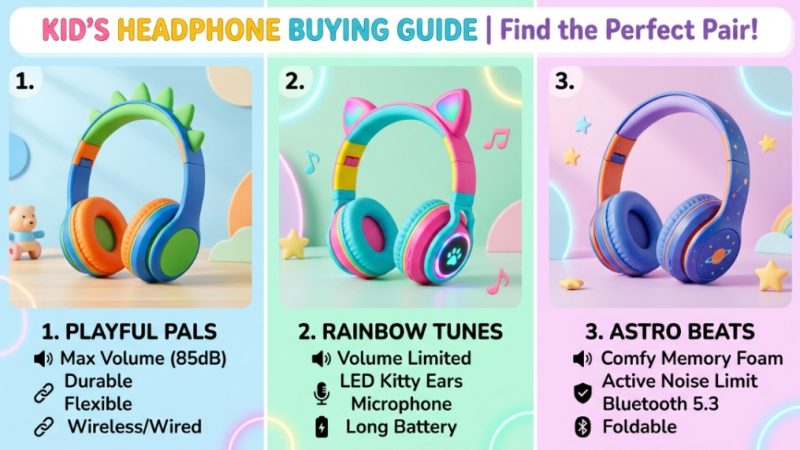
The best overall travel headphones for kids are JBL JR460NC (30-hour battery, effective ANC, foldable, $50–$70), BuddyPhones Cosmos+ (152g ultralight, 24-hour battery, foldable flat, $60–$80), and Puro BT2200 Plus (audiologist-certified safety, 22-hour battery, travel case included, $80–$100).
- JBL JR460NC — Best all-around travel: 30-hour battery covers any journey worldwide. Effective ANC for aircraft noise. 85dB volume cap. Foldable flat with included carry pouch. Aux cable included. Built-in mic for calls. $50–$70. The single best recommendation for most traveling families with children 6–12.
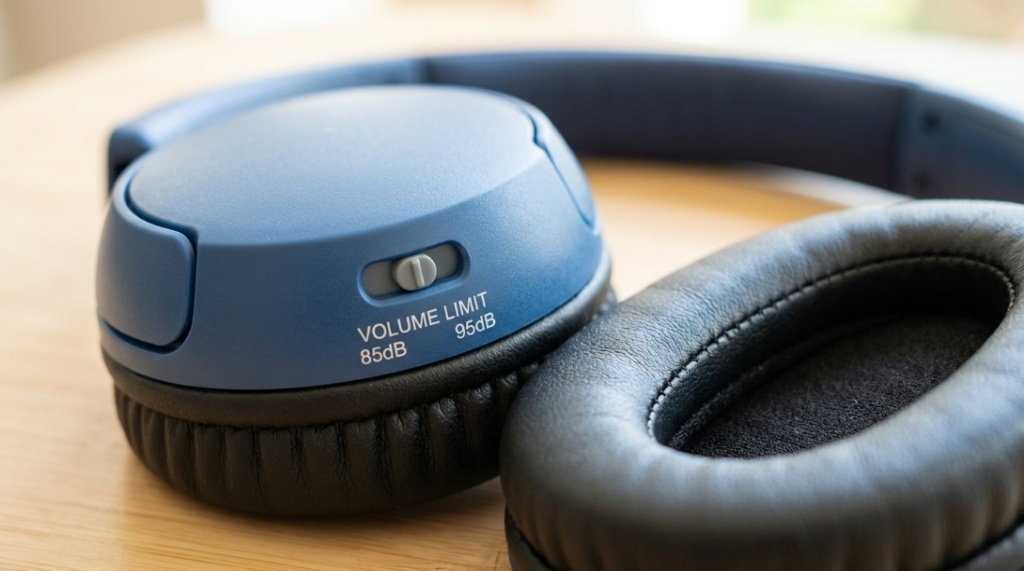
- BuddyPhones Cosmos+ — Best for younger travelers: 152g ultralight (lightest ANC option). 24-hour battery. Foldable flat to near-book-thickness. Switchable 75/85/94 dB limits. Hypoallergenic cushions. $60–$80. Ideal for children 4–8 who need maximum comfort at minimum weight during long journeys.
- Puro BT2200 Plus — Best hearing safety for travel: Audiologist-designed and verified 85dB limiter. 22-hour battery. 82% ambient noise reduction. Includes semi-hard zippered travel case. Premium cushions for extended flight comfort. $80–$100. Best for parents prioritizing verified hearing safety above all other factors.
How Do You Pack and Protect Kids’ Headphones for Travel?
Pack headphones in a protective case within the child’s personal item (backpack or small bag)—accessible without opening overhead bins—with the charging cable, aux cord, and any adapters together in the same case pocket for immediate availability upon boarding.
- Case selection: If headphones include a case, use it. If not, a small semi-rigid pouch ($8–$15) prevents crushing damage and keeps cables organized. Hard cases protect best; soft pouches protect adequately for cabin travel.
- Packing location: Always in carry-on personal item (under-seat bag or child’s backpack). Never in checked luggage (inaccessible during flight). Position for quick access without full bag excavation — outer pocket or top compartment. Children need headphones immediately upon boarding (engine noise starts during taxi).
- Cable management: Coil aux cable and charging cable together. Secure with a cable tie or small pouch. Loose cables tangle with other bag contents and get damaged by being pulled accidentally when retrieving other items.
- Spare planning: For international travel or multi-week trips, consider packing a basic backup pair of wired volume-limited earphones ($10–$15) in checked luggage. If primary headphones break or get lost, the backup prevents the remainder of the trip without hearing protection.
Conclusion
Travel-friendly noise-canceling headphones for kids need to do more than cancel noise—they must survive travel’s physical demands, last longer than any journey on a single charge, fold compact enough for children’s limited bag space, and connect to every audio system encountered from airport to airplane to car. The models that achieve all these requirements simultaneously (JBL JR460NC, BuddyPhones Cosmos+, and Puro BT2200 Plus) represent the current gold standard for kids’ travel headphones—each delivering the complete package of ANC, safety, comfort, and travel-specific engineering that family trips demand.
Invest once in proper travel headphones and benefit across every trip your family takes for the next 2–3 years. The $50–$100 investment eliminates noise-induced child meltdowns, prevents hearing damage from volume escalation in loud environments, enables genuine sleep during red-eye flights, and transforms travel from an endurance challenge into a manageable experience. For families who travel more than twice annually, airplane headphones for kids aren’t optional comfort—they’re essential travel infrastructure.
Frequently Asked Questions
Can kids use ANC headphones on all airlines?
Yes—all major airlines permit Bluetooth headphones and ANC headphones during flight (once electronic devices are allowed after taxi). Some airlines require headphones off during safety briefings. ANC headphones use sound waves, not radio frequencies, and don’t interfere with aircraft systems. For seatback entertainment requiring wired connection, use the included aux cable.
Should I buy separate headphones for travel and home use?
Not necessary if you choose a versatile model. The JBL JR460NC and BuddyPhones Cosmos+ work equally well for home study and travel — their ANC, comfort, and volume safety apply identically in both contexts. One quality pair serving both purposes is more practical than managing two separate pairs that children will confuse, lose, or prefer one over the other.
What if my child’s headphones die mid-flight?
Most ANC headphones with an aux cable continue playing audio in wired mode even with a dead battery—though ANC stops functioning. The child can still listen to content at a safe volume (the limiter remains active in wired mode for quality brands), just without noise cancellation. Bring the aux cable as standard practice to ensure wired backup always exists.
Are there headphones suitable for both toddlers and older kids?
BuddyPhones Cosmos+ comes closest—its adjustable headband fits ages 4–12, and the switchable volume limit (75/85/94 dB) adapts to different ages. However, no single headphone perfectly serves a 3-year-old and a 12-year-old simultaneously. For families with widely different ages, two appropriately sized models serve better than one compromise pair.
How do I clean kids’ headphones after travel?
Wipe ear cushions and headband with a slightly damp cloth after each trip. For deeper cleaning: remove ear cushions (if detachable), wipe with a 70% isopropyl alcohol wipe (kills bacteria from plane/hotel contact), and allow to dry completely before reattaching. Clean the headband padding with mild soap and water. Never submerge electronics or use excessive liquid near speaker openings.
Do kids’ ANC headphones work in cars as well as planes?
Yes, effectively. Car road noise (65–75 dB) is lower intensity than airplane noise—meaning kids’ ANC headphones that handle aircraft environments easily manage car noise. In cars, ANC particularly helps children sleep during drives and focus on audiobooks/schoolwork during road trips. The ANC effectiveness feels even more dramatic in cars because the starting noise is lower—reduction to near-silence feels more complete.