
Every headphone marketing page claims “exceptional sound quality” — but when two headphones both claim excellence, how do you actually determine which one sounds better for YOUR ears and YOUR music? A Marshall headphones review will praise the warm mid-forward signature while a Sennheiser review praises neutral accuracy — both call it “excellent sound quality” without explaining that they’re describing opposite tuning philosophies. Sound quality comparison isn’t about finding the objectively “best” headphone — it’s about understanding what specific characteristics you’re hearing, learning the vocabulary to describe them, and matching those characteristics to your personal preferences and music library.
Sound quality in headphones encompasses multiple measurable and subjective dimensions: frequency response (which sounds are emphasized or reduced), soundstage (perceived width and depth of audio), imaging (ability to locate individual instruments in space), dynamics (contrast between quiet and loud passages), and distortion (unwanted artifacts at any volume). Expert comparison evaluates each dimension independently rather than reducing everything to “sounds good” or “sounds bad.”
This guide teaches you the actual methodology audio professionals use to compare headphone sound quality — so you can evaluate any Marshall headphones review (or any brand’s review) with informed ears rather than trusting someone else’s subjective preference as universal truth.
What Are the Key Dimensions of Headphone Sound Quality?
Five dimensions define headphone sound quality: frequency response (tonal balance across bass, mids, treble), soundstage (perceived spatial width), imaging (instrument position accuracy), dynamics (volume contrast handling), and detail retrieval (ability to hear subtle elements in complex recordings).
| Dimension | What It Means | How to Test | Marshall Characteristic |
|---|---|---|---|
| Frequency Response | Which frequencies are louder/quieter relative to each other | Listen to familiar tracks — notice if bass, vocals, or cymbals sound different than expected | Warm: boosted lower-mids, punchy bass, slightly recessed treble |
| Soundstage | How wide/deep the music feels — speakers-in-room vs. inside-your-head | Close your eyes — does music sound like it’s coming from around you or from a point? | Moderate — intimate presentation, music feels close rather than distant |
| Imaging | Can you “point to” where each instrument sits in the stereo field? | Listen to orchestral or well-produced rock — can you locate guitar left, drums center, keys right? | Good — instruments are distinguishable but not surgically separated |
| Dynamics | How well quiet passages feel quiet and loud passages feel impactful | Listen to music with volume contrasts — does the quiet part feel genuinely soft? | Good — punchy transients, satisfying impact on drum hits and guitar strums |
| Detail Retrieval | Ability to hear subtle textures, breaths, finger slides, room ambience | Listen for tiny background elements you know exist in familiar recordings | Moderate — prioritizes musical engagement over micro-detail analysis |
No headphone excels equally at all five dimensions. Marshall prioritizes frequency response (engaging warm tonality) and dynamics (punchy, alive feel) over soundstage and detail retrieval. Sennheiser prioritizes detail and neutral frequency response. Sony balances all five moderately. Your preference determines which trade-off serves you best.
How Do Experts Actually Listen When Comparing Headphones?
Experts use reference tracks they’ve heard hundreds of times on many systems, compare one specific dimension at a time (not overall impression), volume-match both headphones precisely before switching, and listen in the same quiet environment to isolate headphone differences from environmental variables.
Expert comparison methodology:
- Step 1 — Volume match: Use a decibel meter app (free on any phone) to match both headphones to identical volume (within 1dB). Even 2–3dB louder sounds “better” to human perception regardless of actual quality — this bias invalidates comparisons without volume matching.
- Step 2 — Reference tracks: Use 5–8 songs you’ve heard hundreds of times. You know exactly what these should sound like. Any deviation reveals the headphone’s coloration. Mix genres: one with deep bass, one with acoustic detail, one with wide stereo mixing, one with complex layering.
- Step 3 — Single-dimension focus: Listen to the same 30-second passage on both headphones, focusing ONLY on bass. Then repeat focusing ONLY on vocals. Then imaging. Evaluating everything simultaneously overwhelms perception and produces vague “I think this one is better” impressions rather than specific assessments.
- Step 4 — Quick switching: Switch between headphones within 10–15 seconds. Auditory memory fades rapidly — comparisons more than 30 seconds apart become unreliable. Quick A/B switching reveals differences your memory would lose over longer gaps.
- Step 5 — Note specific observations: “Bass guitar is more prominent on headphone A” is useful. “Headphone A sounds better” is not. Force yourself to articulate WHAT specifically differs — not just which you prefer.
What Reference Tracks Should You Use for Headphone Comparison?
Use tracks you know intimately across these categories: one bass-testing track, one vocal/midrange track, one detail/treble track, one soundstage/imaging track, and one dynamics track. Familiarity matters more than track quality — you need to instantly notice what’s different.
Recommended reference tracks by testing purpose:
- Bass test: “Royals” by Lorde (clean sub-bass), “Billie Jean” by Michael Jackson (punchy mid-bass), or any track where you know exactly how the bass should feel.
- Vocal/midrange test: “Hotel California” (Eagles, acoustic version), “Fast Car” (Tracy Chapman), or any singer-songwriter recording where the voice is the star.
- Detail/treble test: “Take Five” by Dave Brubeck (cymbal shimmer and brush detail), “Bohemian Rhapsody” (layered complexity), or any track with subtle background elements you can identify.
- Soundstage/imaging test: “Money” by Pink Floyd (moving stereo effects), any well-produced live album where you can “place” band members left/center/right.
- Dynamics test: “In the Hall of the Mountain King” (Grieg — builds from whisper to explosion), any track with dramatic quiet-to-loud transitions.
Your personal references are better than any recommended list — you need tracks where you immediately notice “that bass note sounds different” or “the cymbal is brighter than usual.” That instant recognition requires deep familiarity.
How Do You Read and Interpret Headphone Sound Quality Reviews?
Interpret reviews by translating subjective vocabulary into objective characteristics: “warm” means boosted lower frequencies, “bright” means emphasized treble, “muddy” means overlapping bass bleeding into mids, “analytical” means detailed but potentially fatiguing, “fun” means colored away from neutral in an engaging way.
Review vocabulary decoder:
- “Warm” / “Lush” / “Full-bodied”: Boosted lower mids and bass. Reduces perceived detail but increases listening enjoyment. Marshall’s consistent descriptor across reviews.
- “Bright” / “Airy” / “Detailed”: Emphasized upper frequencies. Reveals more detail but can become fatiguing over hours. Sennheiser and Beyerdynamic often described this way.
- “V-shaped” / “Fun” / “Exciting”: Boosted bass AND treble with recessed mids. Energetic presentation. Common in consumer-tuned headphones from JBL, Skullcandy.
- “Neutral” / “Flat” / “Reference”: Minimal coloration — what was recorded is what you hear. Can sound boring to listeners accustomed to colored headphones. Studio monitor philosophy.
- “Muddy” / “Boomy” / “Bloated”: Excessive bass that masks other frequencies. Negative descriptor indicating poor bass control. Note: what one reviewer calls “boomy” another might call “bass-rich” — perception is relative.
- “Thin” / “Anemic” / “Lacking body”: Insufficient bass or lower-mid presence. Music sounds incomplete or hollow. Often used by listeners accustomed to bass-forward headphones when reviewing neutral ones.
For Marshall-specific sound analysis across their lineup, the Marshall headphones review collection provides per-model sound breakdowns using consistent testing methodology.
How Does Marshall’s Sound Signature Compare to Other Brands?
Marshall delivers a deliberately warm, mid-forward sound with punchy bass and slightly softened treble — designed to make rock, indie, and vocal music sound engaging and alive. This contrasts with Sony’s adaptable neutrality, Bose’s relaxed comfort tuning, and Sennheiser’s analytical accuracy.
Brand sound philosophy comparison:
- Marshall: “Concert in a good venue” — warm, musical, slightly colored toward engagement over accuracy. Guitars sound alive. Vocals feel present and forward. Bass is punchy without being boomy. Treble is smooth, not fatiguing.
- Sony: “Versatile studio” — neutral baseline with app-adjustable EQ for any preference. Technically more capable but less immediately characterful. Adapts to your preference rather than imposing one.
- Bose: “Comfortable listening room” — warm, non-fatiguing, slightly smooth. Prioritizes relaxed listening over detail or excitement. Easy to listen to for hours without fatigue.
- Sennheiser: “Mastering studio” — neutral to slightly bright, detail-focused. Reveals everything in a recording including flaws. Rewards well-produced music, punishes poor recordings.
- Beyerdynamic: “Analytical precision” — very detailed, wide soundstage, bright treble. Excellent for classical and acoustic. Can fatigue treble-sensitive listeners over long sessions.
There is no objectively “best” sound signature — only personal preference and genre matching. Marshall’s warm signature specifically flatters guitar-driven music, vocals, and rhythm-focused genres. It’s deliberately less suited for listeners who prioritize analytical precision or genre-agnostic neutrality.
What Are Common Mistakes People Make When Comparing Sound Quality?
The three biggest comparison mistakes: not volume-matching (louder always sounds “better”), comparing after extended use of one pair (ears adapt to any signature within hours, making the familiar pair always “better”), and evaluating in noisy environments where ambient sound masks actual headphone differences.
Mistakes that invalidate comparisons:
- Volume bias (most common): A headphone that plays 2–3dB louder at the same volume setting sounds better to human hearing regardless of actual quality. ALWAYS volume-match with a measurement tool before comparing.
- Adaptation bias: After wearing headphones for 2+ hours, your brain adapts to their signature as “normal.” Switching to any different headphone immediately sounds “wrong” — even if it’s objectively better. Solution: compare within 15-second intervals, not after extended sessions.
- Environment contamination: Comparing headphones in a noisy café gives false impressions. External noise masks treble detail, making bright headphones seem less different from warm ones. Compare in the quietest room available.
- Source quality confusion: Comparing using poor-quality MP3s or Bluetooth with SBC codec can mask differences between headphones. Use the highest quality source available (lossless if possible, AAC minimum) for meaningful comparison.
- Expectation bias: Knowing one headphone costs $300 and another costs $100 biases your perception before you even listen. True blind testing (not knowing which is which) is the only way to eliminate this, but it’s difficult to arrange with different physical headphone formats.
How Do You Determine YOUR Personal Sound Preference?
Listen to three different headphone signatures (warm, neutral, V-shaped) on the same 3–4 reference tracks. Whichever makes you instinctively enjoy the music most — not which sounds “most accurate” — is your preference. Don’t intellectualize the choice; trust the emotional response.
Preference discovery process:
- If warm headphones (Marshall, Bose) make you tap your foot and enjoy music more: You prefer colored-warm presentation. Music as enjoyment. You’ll be happy with Marshall.
- If neutral headphones (Sennheiser, Sony flat) let you hear new details and fascinate you: You prefer accuracy. Music as discovery. Look at Sennheiser or studio monitors.
- If V-shaped headphones (JBL, Skullcandy) feel most exciting and energetic: You prefer maximum fun/impact. Music as energy. Consider bass-focused brands.
Most people prefer warm or V-shaped signatures for everyday casual listening. Neutral preference typically develops with audio experience over time or correlates with musician/producer backgrounds. There’s no wrong preference — only mismatched purchases.
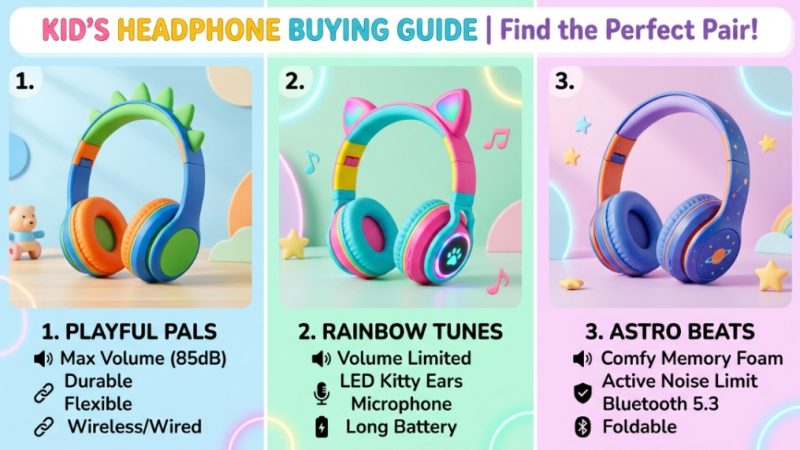
While evaluating high-end audiophile gear requires an eye for frequency graphs, choosing proper tuning for younger ears follows a completely different set of safety guidelines. If you are shopping for children, acoustic balance needs to be paired with strict volume-limiting hardware. Check out our comprehensive breakdown of the best Affordable Noise Cancelling Headphones for Kids This Year to ensure their hearing stays protected while maintaining excellent sound isolation.
Conclusion
Comparing headphone sound quality like an expert requires three shifts from casual evaluation: volume-match before comparing (eliminates loudness bias), focus on one dimension at a time rather than overall impression (produces specific, useful observations), and use deeply familiar reference tracks where you’ll instantly notice differences (beats any recommended “audiophile test track” you’ve never heard before). Apply this methodology to any Marshall headphones review or any brand comparison, and you’ll understand exactly what the reviewer is describing — and whether their preference matches yours.
For Marshall-specific sound quality analysis using expert methodology, the detailed Marshall headphones review guide breaks down each model’s sound character using the dimensional framework described above.
What’s your sound preference — warm, neutral, or V-shaped? And what test track instantly reveals headphone character to your ears? Share your reference in the comments — building a community reference library helps everyone compare more effectively.
Frequently Asked Questions
Does price always equal better sound quality?
No. Price correlates with sound quality up to approximately $300 for wireless headphones, after which improvements become marginal and increasingly subjective. A $150 headphone tuned to your preference sounds “better” to you than a $500 headphone tuned for a different preference. Match tuning philosophy first, then optimize within that philosophy by price.
Can you really hear the difference between headphones?
Yes — between headphones with different tuning philosophies (warm vs. neutral vs. V-shaped), differences are immediately obvious to any listener. Between headphones with similar tuning at different price points within the same brand, differences are subtle and require trained listening and proper A/B comparison technique to identify reliably.
Are Marshall headphones considered high-quality audio?
Marshall headphones deliver high-quality consumer audio with a deliberately warm, musical tuning. They’re not studio reference equipment (not designed to be). They’re well-engineered listening headphones that prioritize musical enjoyment over clinical accuracy. “High quality” depends on your definition — for engaging music listening, yes. For recording studio reference, no.
Does streaming quality affect headphone sound comparison?
Yes. Standard Spotify streaming (160kbps on free, 320kbps on Premium) may not reveal subtle differences between headphones. Lossless streaming (Apple Music Lossless, Tidal, Amazon HD) provides more information for headphones to reproduce — making differences more audible. For meaningful comparison, use the highest quality source available.
How long does it take to properly evaluate a new headphone?
Allow 3–5 days of regular listening before forming final judgment. Your brain adapts to new sound signatures over 48–72 hours of exposure — initial impressions on day 1 are heavily biased by what you listened to previously. By day 5, you’ve adapted and can evaluate the new headphone on its own merits rather than in contrast to your old pair.
Why do reviewers disagree about the same headphone’s sound quality?
Reviewers have different preferences, different reference points, and different ears (ear canal shape affects perceived frequency response). A reviewer who prefers neutral sound will describe Marshall as “too warm.” A reviewer who prefers warm sound will describe Marshall as “perfectly tuned.” Both are honest assessments from different preference starting points. Find reviewers whose preferences match yours for most useful guidance.
Can EQ settings make any headphone sound like any other?
Partially. EQ can shift frequency balance — making warm headphones sound more neutral or vice versa. However, EQ cannot change soundstage, imaging quality, dynamic capability, or driver distortion characteristics. These are hardware-dependent. EQ adjusts tonality (which frequencies are louder) but not fundamental driver performance characteristics.